LANSA-BRAC concluding seminar on ‘Leveraging Agriculture for Nutrition in Bangladesh’
A concluding seminar for the ‘Leveraging Agriculture for Nutrition in South Asia (LANSA)’ programme of BRAC was held on 23rd July 2018 at the BRAC centre in Dhaka. A synthesis of findings from all LANSA-BRAC studies were presented at the half-day seminar titled ‘Leveraging Agriculture for Nutrition in Bangladesh’. Highlights of Agriculture-Nutrition programmes of FAO in Bangladesh and Health-Nutrition programmes of BRAC in Bangladesh were also presented. Additional Secretary (Research) of Ministry of Agriculture, Fazle Wahid Khondaker was the chief guest on the occasion while Director, Institute of Public Health and Nutrition under the Ministry of Health and Family Welfare, Dr Samir Kanti Sarker spoke as special guest at the seminar. Dr. Imran Matin, Executive Director of BRAC Institute for Governance and Development (BIGD), BRAC university, chaired the session. The seminar was attended by 76 participants including policy influencers, experts, researchers, practitioners and others.
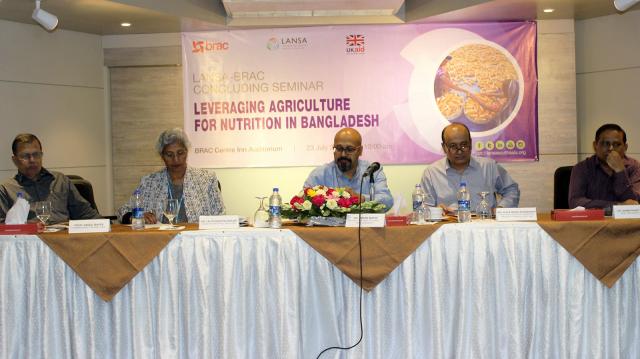
Former Director of BRAC and Team Lead of LANSA-BRAC, Prof. Abdul Bayes gave the welcome address in the seminar.
While presenting the synthesis of LANSA findings in Bangladesh, Barnali Chakraborty, LANSA Researcher and Senior Research Fellow, BRAC mentioned that malnutrition is pervasive in haor and coastal areas because of backwardness in both infrastructure and modern technology. Agricultural diversity leads to dietary variety possibly indicating that agricultural policy needs to shift focus from mono-cropping to multi-cropping system thorough infrastructure and incentive schemes. Production-oriented agriculture has varying impacts on nutritional outcomes, such as anaemia, blindness etc. There is a knowledge gap on the role of women in intra-household resource allocation and other non-food and nutrition-related investment. Also, knowledge gaps exist about spending of agricultural income for nutritional improvements at household level.
Dr. Lalita Bhattacharjee, a Senior nutritionist of FAO, in her presentation, highlighted the policies and programmes and the lessons learned from various Bangladeshi projects supported by FAO. The lessons to drive home are as follows: (a) importance of horticulture, livestock and aquaculture for production and consumption diversification, healthy, sustainable diets; (b) introduction of nutrition education and cooking demonstrations, focusing on household and women's dietary diversity, complimentary feeding, healthy cooking, and (c) adoption of appropriate processing technologies. These are linked to national food and nutrition policies and the first Country Investment Plan for agriculture. She also mentioned that malnutrition remained as a menace to both upper and lower quartile of wealth groups. She put forth some recommendations in the fight against malnutrition, such as (i) engaging national and local governments to work simultaneously on policy, capacity strengthening and action on the ground; (ii) embedding nutrition-sensitive agriculture through multi-sectoral collaboration; (iii) monitoring and evaluation of shortage of funds for investment; (iv) harmonization, data exchange and monitoring of nutrition outcomes and impact; (v) need for evidence/research and tools to inform and improve policy.
Dr. Mahfuza Rifat, Programme Head of Health, Nutrition and Population Programme of BRAC presented a paper on Nutrition Interventions of BRAC.
Special Guest Dr. Samir Kanti Sarker said, “There is a need for health education along with regular education system.” “Knowledge regarding food is necessary to ensure nutrition outcomes, he said, adding that we need to have an integrated approach towards building this knowledge.
Speaking at the seminar, Chief Guest Fazle Wahid Khondaker said that the government is working towards attaining the Sustainable Development Goals (SDGs) by 2030. Agriculture remains the most important tool to achieve the targets and overall development. But, right now agriculture in the country is facing major challenges with adverse effects of climate change, non-availability of labour shortage, floods and flash floods, severe storms, tidal surges, and other natural disasters. He said that agriculture is directly related to our food and nutrition. So, we are working towards sustainable agricultural practices/systems and food security. To achieve the goal, all sectors need to work in close collaboration with each other.
Session Chair Dr. Imran Matin, raised some pertinent points in his concluding remarks. Admitting that there has been improvement in nutritional status over time, the progress has been relatively slow compared to others. He opined that the main challenge is to accelerate the pace, and not to bear with business as usual scenario. What is needed is a game of fostering steepness in the reduction of malnutrition. Apparently, LANSA has been a diagnostic type of study searching for causalities and consequences of malnutrition, but now the time seems to be ripe for interventions; and those interventions are needed based on robust empirical analyses.
Agriculture matters, pathways are powerful but three things have to be focussed on: the role of information, the role of incentives and the role of behaviour. Nutrition is primarily a behavioural outcome, and we need information and incentive to change behaviour. Bangladesh is undergoing massive changes, but one of the big changes yet to come is in the area of hardcore malnutrition with a focus on less favourable areas and economically disadvantaged groups. Finally, technology has a major role to play as the game changer. Digitalisation needs to be emphasized in the whole chain of policy to practice, farm to fork, and research to realities on the ground.
Speakers discussed different approaches to combat malnutrition for the poor like school nutrition/feeding programme, encouraging more consumption of milk, increased food storage and processing capacity et cetera.
They recommended that special programmes should be adopted in response to special needs of geographically fragile and vulnerable areas of the country.
Experts and researchers from IFPRI, EU Delegation, ICDDB, WHO, FAO, Helen Keller International, Concern worldwide, GAIN Alliance, Solidaridad, Harvest Plus, SNV, FHI 360, Alive and Thrive, TMSS, BFSA, IPHN, DGHS Ministry of Food, and various local NGOs and relevant divisions of BRAC attended the seminar.
The event was widely covered by the press media.
Links to media:
English Dailies: Financial Express , The Independent: Link1 Link2 Link3 , Daily Sun: Link1 Link2 , New Age , Daily Star , The Observer ,
National News Agencies: BSS , UNB
Bangla Dailies: Sangbad , Prothom Alo Link 1 Link2 , Bhorer Kagoj , Kaler Kantho , Samakal Link1 Link2 , Amader Somoy , Bonik Barta , Naya Diganta
Online News Portals: Somoy news , News Bengali24.com
TV Channel: Somoy News TV channel